
It is that time of year again. Selection Sunday for the 2013 NCAA Men's Basketball Tournament is just ten days away, and the road to the Final Four at the Georgia Dome in Atlanta starts with the selection of 68 teams. One of the best parts of March is spotting the Cinderella teams that sneak into the dance.
Automatic bids
Last year 30 teams reached the tournament with automatic bids by winning their conference tournaments. That is the least stressful route in: your fate is in your own hands. Western Kentucky made the field in 2012 with a losing record because it won the Sun Belt tournament. The Ivy League was then the only conference without a tournament; its regular-season champion took the automatic bid. That left the rest of the country fighting over the remaining 37 at-large places.
A season without a dominant team
This season has been refreshing because no single team has held the top spot. Five different teams have been ranked number one over 18 weeks. That parity showed in the Las Vegas futures market too, where as many as eight teams were priced as genuine contenders:
| Team | Futures odds (March 2013) | Implied probability |
|---|---|---|
| Indiana | +500 | 16.7% |
| Duke | +700 | 12.5% |
| Kansas | +700 | 12.5% |
| Louisville | +700 | 12.5% |
| Miami (FL) | +800 | 11.1% |
| Florida | +800 | 11.1% |
| Gonzaga | +800 | 11.1% |
| Michigan | +800 | 11.1% |
Five of those eight had been ranked number one at some point. Interestingly, Gonzaga, number one at the time, had longer odds than four other teams, a sign of how little respect the bookmakers gave mid-major conferences.
Notice something about the right-hand column: those eight teams alone add up to almost 100 percent, and every other team in the field still had a price too. The total of all the implied probabilities is well over 100 percent. That surplus is the bookmaker's margin, and it is much bigger on futures than on single games. We explain it, and how to convert any odds into a probability, in how sports betting odds and the vig work.
The magic number
If your team is on the bubble, the magic number is usually around 20 wins. Last year only two teams in the field won fewer than 20: West Virginia with 19 (an at-large bid) and Western Kentucky with 15 (an automatic bid). Of the 37 at-large teams, 23 had single-digit losses. So teams hovering around 20 wins with more than ten losses are the ones sweating.
ESPN's projections at the time listed 31 teams as locks and another 32 on the bubble, so there was plenty still to play for.
| Conference | Locks | Bubble |
|---|---|---|
| ACC | 4 | 2 |
| Big East | 6 | 3 |
| Big Ten | 5 | 3 |
| Big 12 | 3 | 3 |
| Pac-12 | 2 | 4 |
| SEC | 1 | 6 |
| Mountain West | 4 | 1 |
| Atlantic 10 | 3 | 3 |
| Other mid-majors | 3 | 7 |
| Total | 31 | 32 |
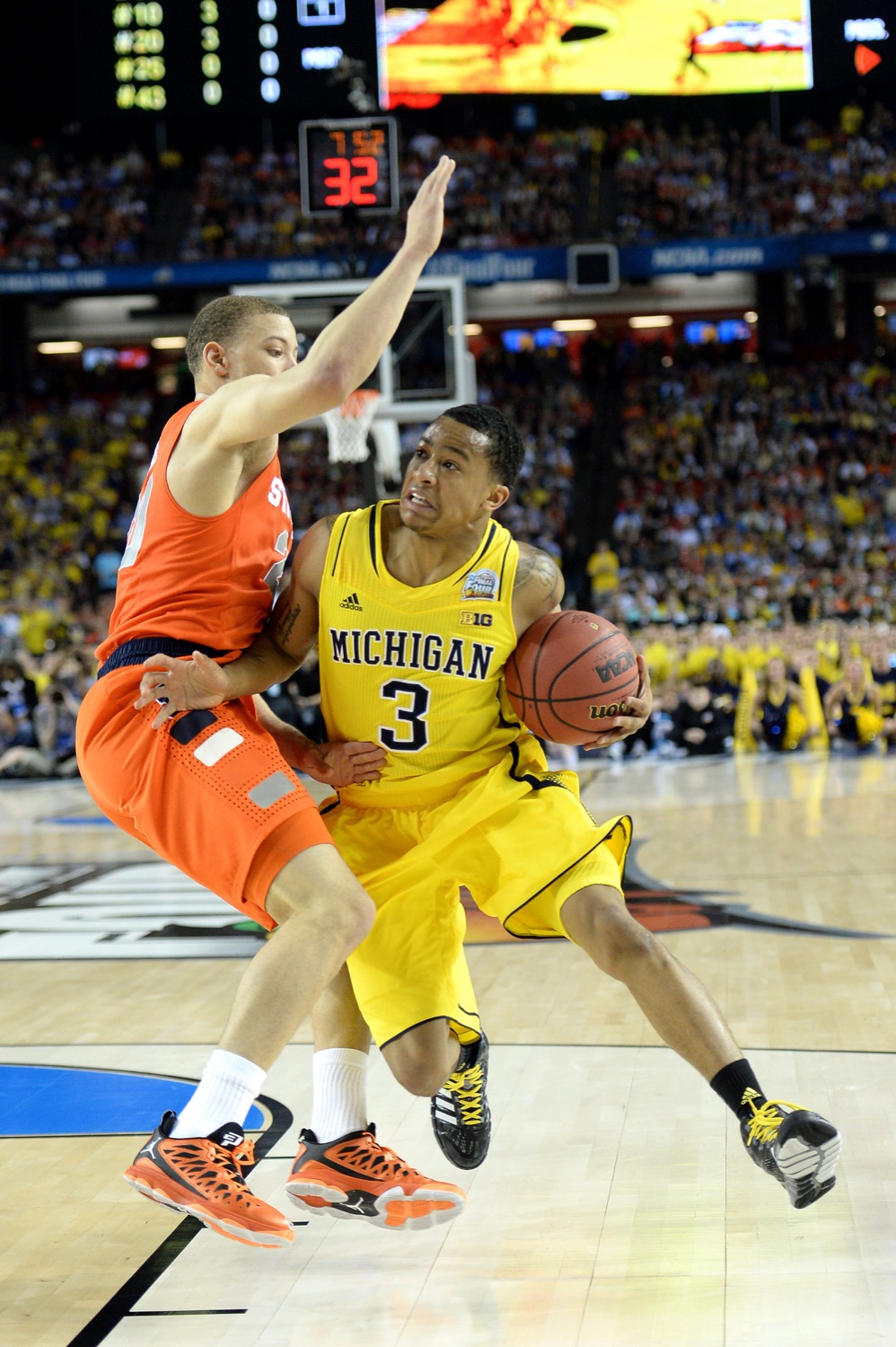
Update (October 2026): Louisville, priced at +700 in the table above, beat Michigan 82-76 in the 2013 final in Atlanta. The title was later vacated by the NCAA in 2018 because of a recruiting scandal. Michigan and Syracuse, pictured above, met in the other semi-final. The Ivy League has since added its own conference tournament, and sports betting, then legal in a full-service form only in Nevada, is now legal in most US states following a 2018 Supreme Court ruling.
Whether you fill in a bracket with friends or follow the odds, the tournament is a great lesson in probability: even the favourite rarely has better than a one-in-five chance before the first tip-off.